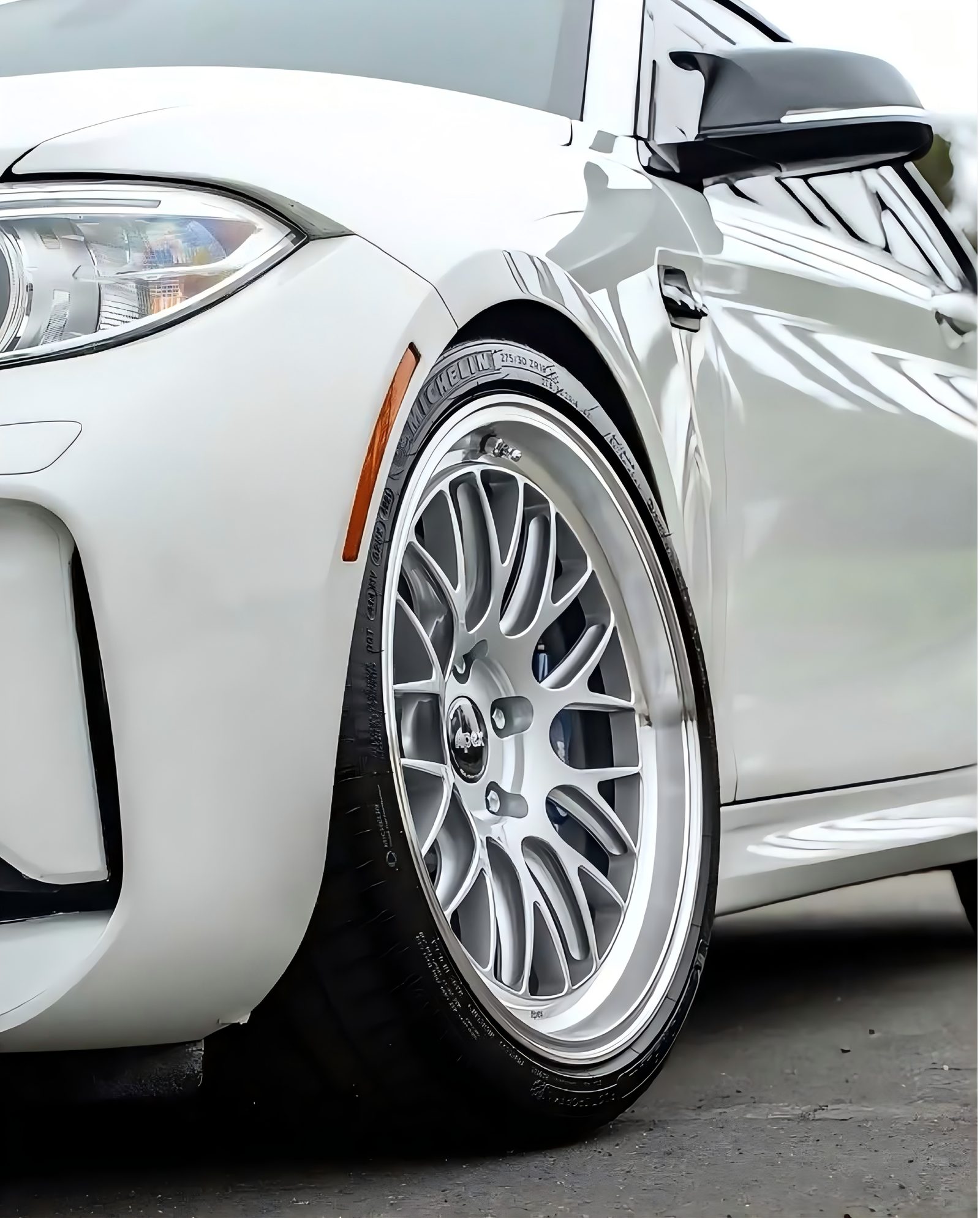
What a road-legal car actually needs for repeated fast laps, how a track wheel differs from both a road wheel and a race wheel, and which specification choices show up in lap-time consistency rather than in a brochure.
Track forged wheels sit between two extremes. A road wheel is designed for impact and long life at moderate load; a competition wheel is designed for a defined cycle count and a scheduled retirement. A track-day wheel has to do both: survive the drive to the circuit, tolerate kerbs and the occasional excursion, and then run repeated fast laps without developing the runout or cracking that ends a weekend early.
That dual duty is what makes the specification interesting. The car still carries a full interior, a registration plate and often a set of road tyres in the boot, so the wheel cannot be as thin as a race part. But it will see brake temperatures and cornering loads far above anything in normal use, so it cannot be as conservative as a pure road part either.
This article covers the load cases that a track-day car actually produces, the specifications that matter for repeated laps, the thermal problem that most wheel buyers underestimate, the tyre and alignment decisions that interact with the wheel, and the inspection routine that keeps a set in service without turning every track day into a rebuild.
What a Track Day Actually Loads
Cornering load dominates, and it is higher than most owners expect. A road-legal car on semi-slick tyres can generate well over one lateral g, and that force passes through the tyre contact patch into the wheel as a bending moment at the spoke. Twenty laps of a circuit produce more high-load cycles in half an hour than a month of road driving.
Braking adds a second load case, and on a heavy car with large discs it is substantial. The torque reaction at the hub reverses direction between acceleration and braking, and that reversal loads the spoke faces and the hub bolts in a way that steady cornering does not. A wheel that is strong in one direction can still be marginal in the other.
Kerb strikes are the third, and they are the reason a track wheel cannot simply be a race wheel. A race car is usually retired or inspected after contact; a road car has to drive home. That single requirement changes how much impact margin belongs in the design.
Heat is the fourth load, and it is continuous rather than episodic. Disc temperatures on a track car can exceed the range where a wheel's bead seat geometry starts to move, and the wheel is also the path by which that heat reaches the tyre bead and the hub. A design that ignores the thermal case can lose bead seat roundness over a season without any visible damage.
Specification Choices That Matter on Track Forged Wheels
Diameter is the first decision and it is usually driven by brake clearance rather than by looks. A smaller diameter with a taller sidewall is often faster on a track car because the tyre is lighter, the gearing is shorter and the sidewall gives some compliance over kerbs. A larger diameter suits a car with very large brakes and looks better on the road, which is why most track-day builds compromise.
Width should follow the tyre, not the other way round. A semi-slick has a recommended rim width range, and mounting at the upper end of that range produces a squarer shoulder that suits track use. Going beyond the range stretches the sidewall and reduces the load capacity the tyre was validated for.
Offset determines track width and scrub radius, and on track it also determines how much the front tyre moves under steering and compression. A modest reduction in offset improves turn-in and widens the track, but too much produces heavy steering, increased bearing load and rubbing at full lock on a lowered car.
Load rating should be stated for the car as it runs on track, including the driver, the fuel load and whatever the owner leaves in the boot out of habit. A wheel rated for a standard vehicle and then used on a stripped, caged car with aero is being asked to do a different job from the one it was validated for.
| Specification | Track-Day Priority | Common Mistake |
|---|---|---|
| Diameter | Smallest that clears the brakes | Choosing by appearance, then adding mass at the rim |
| Width | Matched to the tyre's upper range | Stretching a tyre beyond its stated range |
| Offset | Modest reduction for track width | Going wide enough to rub at full lock |
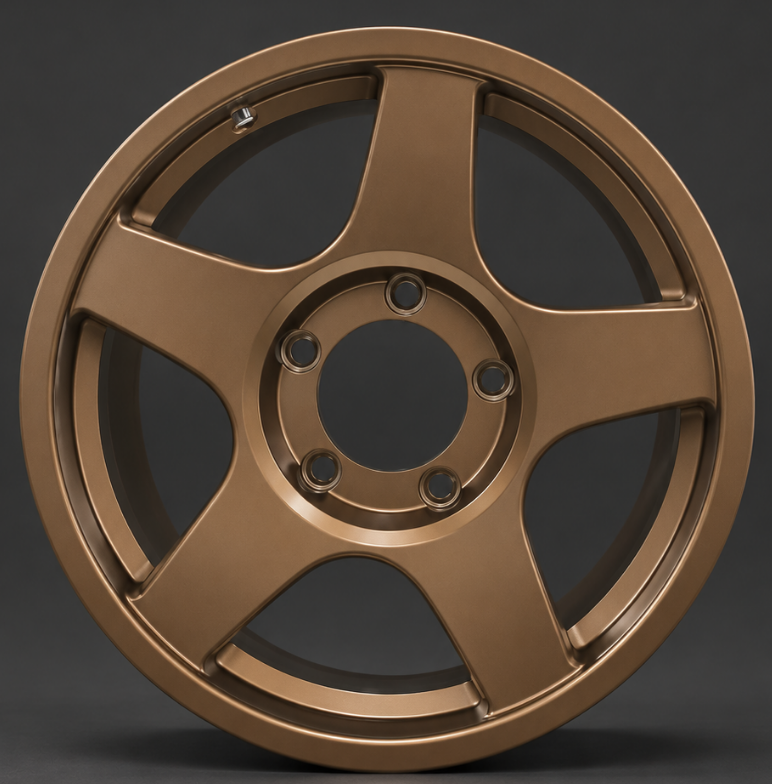
| Spoke design | Open enough for brake airflow | Dense multi-spoke that traps heat |
| Finish | Durable, and able to show cracks | Heavy polish that hides surface damage |
| Load rating | Stated for the car as run on track | Assuming the standard road figure covers it |
| Hardware | Load-rated studs and nuts | Reusing worn or low-grade fasteners |
The Thermal Problem Nobody Plans For
A wheel on a track car runs hotter than most owners realise, and the heat does not come only from the disc. The tyre generates heat through deformation, the brake radiates into the barrel, and the hub conducts heat from the disc hat into the wheel. The bead seat sits between the tyre and the barrel, so it experiences both sources at once.
The visible consequences are a slow pressure rise during a session, which every track driver expects, and a less obvious change in bead seat geometry over time. A wheel that is repeatedly cycled to high temperature will relax slightly, and that relaxation shows up as a pressure loss that no leak detection can find.
Spoke design affects the thermal case as much as the material does. An open face moves air through the brake assembly and cools the disc, while a dense face traps heat and raises both disc and wheel temperatures. A wheel chosen for its appearance can therefore make the brakes worse, which is a counterintuitive result that shows up in pedal feel rather than on a specification sheet.
The practical response is to choose an open design, to check bead seat runout at the start of each season, and to accept that a wheel used hard on track has a shorter service life than one used only on the road. Treating a track wheel as a consumable with an inspection schedule is more honest than pretending it will last indefinitely.
Thermal checks worth doing on a track-day car:
- Measure bead seat runout at the start of the season and again mid-season, and compare the two readings
- Record hot pressures and the drop back to cold, because a change in that pattern signals a geometry issue
- Check the inner barrel for discolouration, which indicates sustained heat beyond the design range
Tyres, Alignment and the Wheel They Share
A track wheel is only one part of a system, and the tyre choice changes what the wheel has to do. A semi-slick generates higher lateral load and transfers it more abruptly than a road tyre, so the spoke sees sharper load cycles. A full slick generates more again, and it also runs at a different temperature, which changes the heat path into the wheel.
Alignment settings interact with offset. Adding negative camber moves the top of the tyre inward, which can create inner arch clearance where there was none, and it changes the load distribution across the contact patch. A car set up for track use often needs a different offset than the same car on standard alignment.
Tyre pressure is the third interaction. A wheel with a stiffer barrel distorts less under load, so the tyre's effective spring rate is slightly higher and the pressure window shifts. Drivers who change wheels and keep the same starting pressures often find the car behaves differently for reasons they attribute to the wheel's weight.
The sensible approach is to change one thing at a time and record the result. A lap-time log with tyre pressures, temperatures and ambient conditions turns a series of impressions into data, and it is the only reliable way to know whether a new wheel specification actually helped.
Durability Expectations for a Road-Legal Track Wheel
A track-day wheel should last several seasons of regular use, provided it is inspected and not abused. The failure modes are progressive: runout increases, balance correction grows, and a crack may appear at a spoke root long before anything is felt through the steering. That progression is why measurement is more useful than opinion.
The single biggest factor in service life is not the wheel but the driver. A smooth driver who stays on the racing surface and avoids kerbs will get far more life from a set than one who uses every centimetre of run-off. That is not a reason to buy a weaker wheel, but it is a reason not to over-specify for a use the car will never see.
Brake package changes matter as well. Fitting a larger disc and caliper after the wheels were bought can create a clearance problem that forces a new set, so the brake plan should be settled before the wheel specification. That sequencing mistake is common and expensive.
Finally, a track wheel should be stored and transported properly. Stacking wheels face to face, leaving them in a hot trailer or resting them on concrete all introduce damage that shows up later as a balance problem. A set of wheel bags and a rack costs very little compared with a replacement.
Weight Reduction Without Losing Margin
On a track-day car the useful weight saving is the one that does not reduce the margin for a kerb strike. That means removing material from the barrel midsection and the spoke windows rather than from the flange, and it means keeping enough thickness at the spoke root that a fatigue crack does not begin after a season of use.
A forged monoblock achieves that through material properties rather than through geometry tricks. The same load can be carried with a thinner section because the grain follows the load path, which is why a forged wheel can be both lighter and more durable than a cast wheel of the same size without any exotic design work.
Owners often ask whether a two-piece wheel is lighter. It is not, in general: the joint, the fasteners and the separate lip usually add mass compared with a monoblock of the same geometry. The advantage of a two-piece design is serviceability and width flexibility, not weight, and buying it for weight is a misunderstanding of what it does.
The cheapest weight saving on a track car is usually not the wheel at all. Removing unnecessary interior trim, a heavy spare and tools that will not be needed at the circuit can save more mass than an upgrade from one forged wheel to another, and it costs nothing. The wheel is worth changing when the existing one is heavy, damaged or dimensionally wrong for the tyre, and not before then, in that order, at all.
Data, Records and Repeatability
A track-day programme improves when it is recorded. Tyre pressures hot and cold, tread temperatures across the width, ambient conditions, lap times and any change to the car together describe whether a modification worked. Without that record, every change is judged by memory and every improvement is partly imagined.
For the wheel specifically, three numbers are worth recording per event: runout at the bead seat, the balance correction weight, and the hot pressure rise. A gradual increase in correction weight or a change in the pressure rise pattern is an early signal that the wheel is changing shape, long before it becomes a visible problem.
Records also make a claim conversation unnecessary, because the history speaks for itself. A set with documented inspections and a consistent pattern is easy to assess, while a set with no history is a matter of opinion on both sides.
The simplest way to start is a page per wheel in a notebook kept with the car. Date, event, measured runout, balance weight, hot pressures and any kerb contact is enough. After two seasons that page is more valuable than any brochure claim, because it describes exactly how the set has been used and what it has done, and a buyer of the car will value it too.
Track Wheel or Race Wheel: Choosing Correctly
A race wheel is optimised for a defined cycle count and a short life, and it is retired on schedule. A track-day wheel has to be durable across years of mixed use, which means more material in the impact-critical areas and a design that tolerates imperfect roads on the way to the circuit.
Choosing a race part for a road car usually produces a wheel that is fragile in the wrong places and expensive to replace, while choosing a pure road part produces one that is heavy and thermally compromised on track. The correct choice is a design that states which compromise it made and why.
- If the car is driven to the circuit, prioritise impact margin and a finish that survives road use.
- If the car is trailered and runs slicks, a lighter specification with a defined retirement interval is reasonable.
- If the car is shared between road and track, choose the more conservative option and accept the extra mass.
- In every case, write down the inspection interval before the first event rather than after the first problem.
Fitment Notes for Popular Track Platforms
Track-focused builds tend to cluster around a small number of platforms, and each has its own constraint. On a rear-engined coupe the rear arch is generous but the front is limited by steering sweep and a large caliper, so staggered widths are normal and the front offset is the number that decides whether the build works.
On a large GT car with all-wheel drive, the front brake package is often the limiting factor and the wheel has to clear a caliper that sits far outboard. Deep concave designs need the spoke flattened near the hub to make room, which is why the visual depth on those cars is usually greater at the rear.
On a front-driven hot hatch the constraint is usually the inner arch and the strut, and a wide wheel with a low offset can produce rubbing on the inner liner at full lock. A modest width increase with a carefully chosen offset is almost always faster than a wide wheel that rubs.
Our platform guides for the 911 fitment and concavity and for the GT-R fitment and buying guide set out the measurements for those two platforms in the same format, and the same method applies to any car.
How RETA Supports Track-Day Builds
RETA has produced forged wheels in Ningbo since 2012, with the company founded in 2009, a 12,000 square metre plant and more than 100 staff. Track-oriented programmes use the same forging base as the road range, with section thickness and alloy chosen against the load case the customer describes rather than against a generic performance claim.
The quality system covers ISO 9001, ISO 14001, ISO 45001 and IATF 16949, with national high-tech enterprise status granted in 2021. Internal limits are held tighter than the SAE, JWL and PCT sequences we design to, and 30-degree and 90-degree impact and deformation tests are added because a track car that clips a kerb loads the wheel at an angle a radial test never reproduces.
Commercially, the minimum order is one set of four wheels, standard sizes run in roughly 7 to 15 working days and fully custom designs take about 25 to 35 working days. Most track builds start from the one part forged wheel range, where the weight and load rating are already documented for common fitments.
We exhibit at SEMA, where the brand received the 2023 Best Innovative Wheel Brand Award, and track-day enquiries there usually start with a brake upgrade rather than a wheel design. That is the correct order: the SSD 2P series can then be specified around a brake package that is already fixed.
Frequently Asked Questions
Q1. Are track forged wheels different from racing wheels?
Yes. A track-day wheel has to survive road use on the way to the circuit and tolerate kerbs without retirement, so it carries more impact margin and a different service philosophy. A race wheel is lighter, thinner and retired on a defined schedule.
Q2. Should I go down a wheel size for track use?
Often yes, if the brakes allow it. A smaller diameter reduces rotating mass, shortens gearing and gives more sidewall compliance over kerbs. The limit is caliper clearance, which is why big brake kits usually force the diameter back up.
Q3. How often should track wheels be inspected?
A visual check at every event, a runout and balance check at the start and middle of the season, and a closer look at the spoke roots whenever the wheels are off the car. Any sudden change in balance weight or runout deserves investigation before the next session.
Q4. Does a lighter wheel make a noticeable difference on track?
The biggest gains come from reduced unsprung mass over kerbs and from lower rotational inertia out of slow corners. On a smooth circuit the difference is smaller than the effect of tyre choice, which is why the tyre should be decided first.
Q5. Can I run the same wheels on road and track?
Yes, and many owners do, provided the design has enough impact margin and the finish survives road conditions. The compromise is that a wheel optimised for both is slightly heavier than a dedicated track set and slightly less comfortable than a purely road-oriented design.
Send us your brake package, tyre choice and expected track use, and we will specify track forged wheels with the impact margin and thermal behaviour that match how the car is actually driven.
Browse Track Fitments Send Your Setup