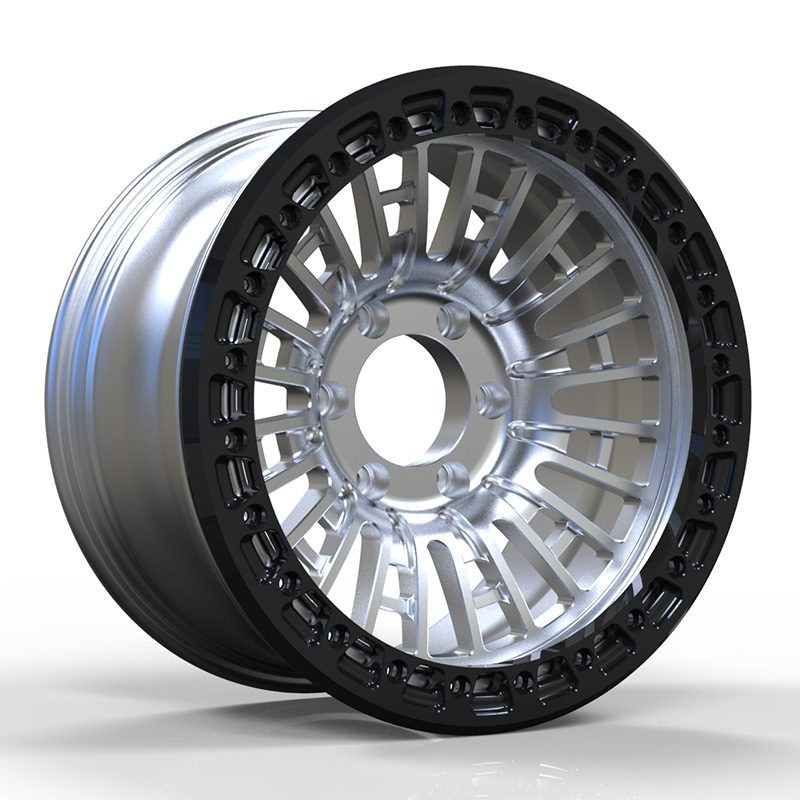
What changes when a wheel is designed for a load spectrum rather than a pothole, how mass is removed without removing margin, and why a race wheel has a retirement date.
Racing forged wheels are designed against a different set of assumptions from road wheels, and the differences are not cosmetic. A road wheel is sized for an occasional severe impact and a long life at moderate load. A race wheel is sized for a very high number of load cycles at high cornering force, with a much shorter service life and a defined inspection regime that decides when the part is retired.
That reversal explains most of the design choices. A race wheel can be thinner in places a road wheel cannot, because it will never see a kerb strike at speed on a broken surface. It can use a more aggressive spoke layout, because the load direction is known and repeatable. And it must be inspectable, because the failure mode being managed is fatigue rather than a single overload.
This article covers the load cases that actually govern a competition wheel, the structural decisions that follow from them, the manufacturing problems that appear when a wheel is machined thin, the inspection and retirement criteria that belong in any serious programme, and the categories where a forged wheel earns its cost over a flow formed alternative.
The Load Cases That Govern a Race Wheel
The dominant load in circuit racing is cornering bending, applied to the spoke and barrel thousands of times per hour. Each corner entry and exit is a cycle, and a long endurance race accumulates a cycle count that a road wheel would take years to reach. Fatigue design therefore governs the spoke root, not static strength.
The second load is braking torque, transmitted through the hub and the spoke faces. On a car with a large brake package and sticky tyres, the torque reversal under repeated heavy braking is significant, and it loads the hub-to-spoke transition in a direction the cornering case does not cover. A design optimised only for cornering can be weak in this second direction.
The third is impact, and it is the one that separates racing categories. A track car that runs kerbs and occasional off-track excursions still needs impact margin, while a car that runs only on smooth asphalt can trade some of that margin for mass. Buyers should define which case applies rather than assuming a race wheel is universally stronger.
The fourth is thermal. A wheel close to a carbon brake disc runs hot, and the resulting expansion affects the bead seat and the nut or stud interface. A wheel that is geometrically correct cold can lose bead seat roundness when it is hot, which shows up as a slow pressure loss or a vibration that appears only late in a stint.
Structural Decisions in Racing Forged Wheels
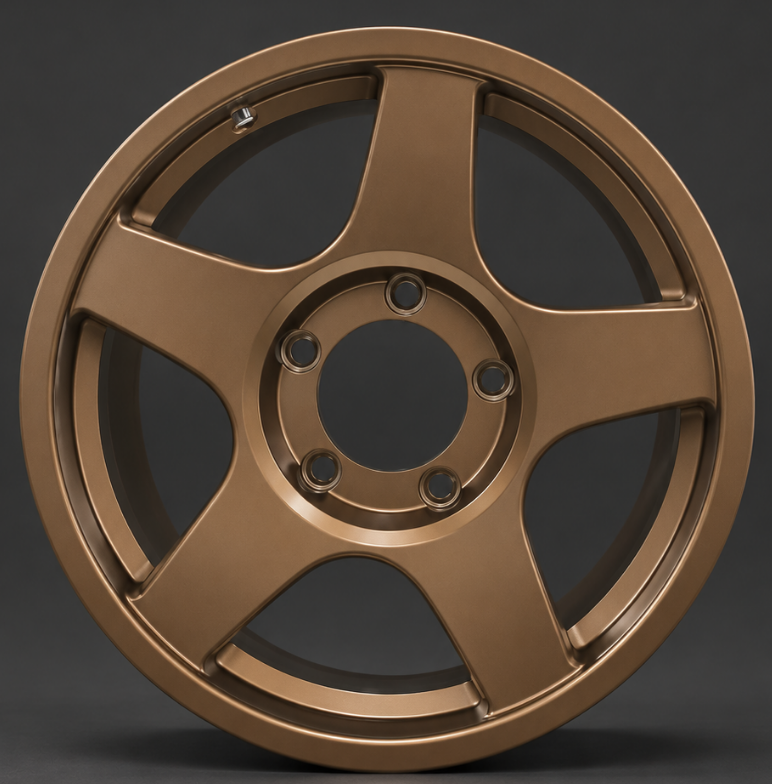
The first decision is spoke count and section. Fewer, deeper spokes give a stiffer structure for a given mass and clear more space for brake cooling air, which is why open five-spoke and split-spoke layouts dominate circuit racing. The penalty is that each spoke carries a higher load, so the root has to be designed carefully and inspected regularly.
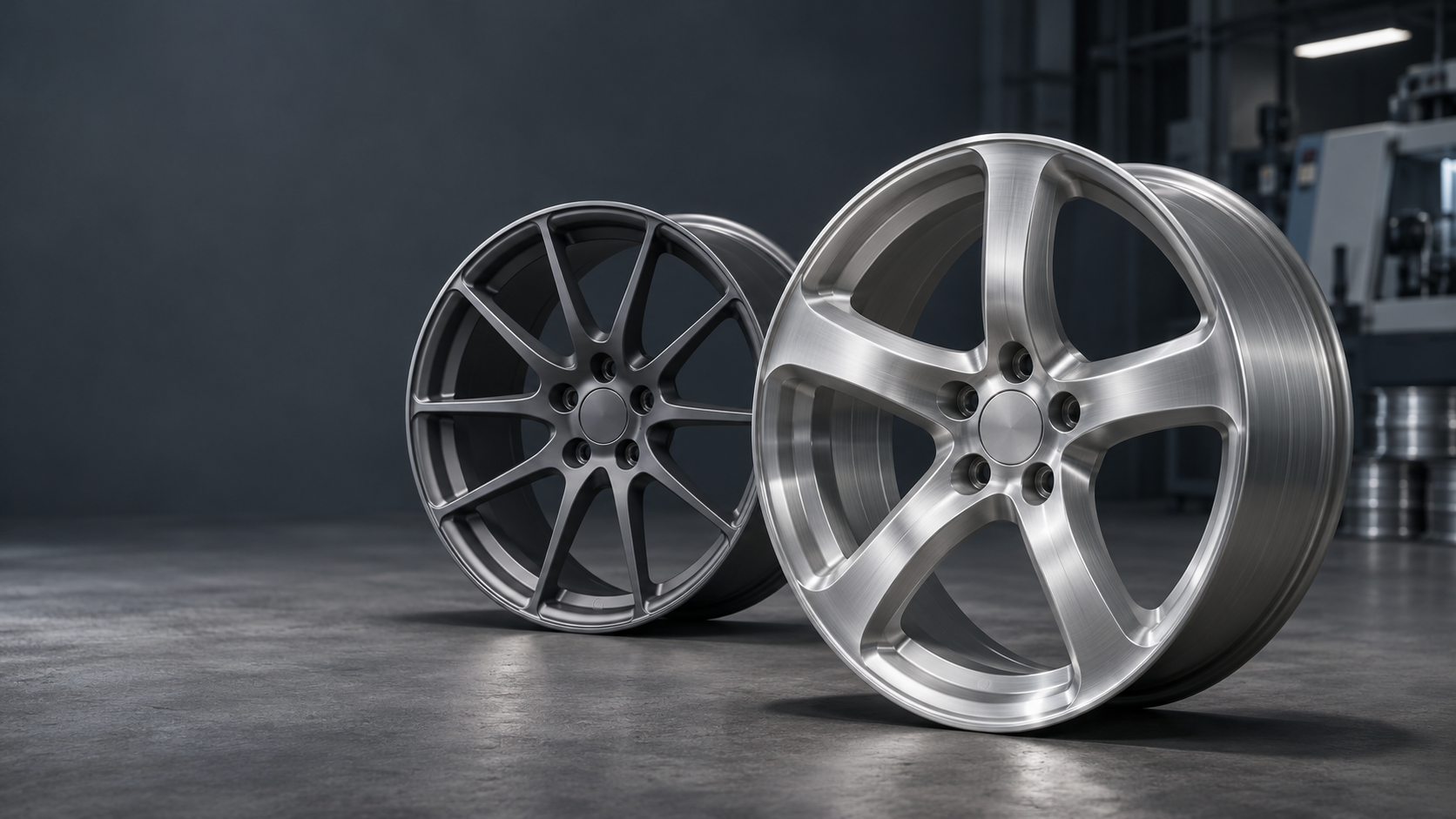
The second is the barrel. A race wheel typically uses a thinner barrel wall than a road wheel, which reduces mass at the worst radius for inertia and improves airflow. The limit is not strength but buckling and bead retention under cornering deflection, because a thin barrel distorts more under side load and can allow the bead to creep.
The third is the hub interface. Center lock dominates in categories where pit stops matter, while studded patterns remain in categories where the rule book or the existing running gear requires them. The hub has to be designed with the fastener system rather than adapted to it, because the load path through a single nut differs from the path through five studs.
The fourth is the mating face. On a race wheel the mounting face is machined flat and often grooved or coated to increase friction, because a slight movement between wheel and hub under repeated torque reversal causes fretting that eventually destroys the face. That detail is invisible to a buyer comparing photographs and decisive to a team comparing lap times over a season.
| Parameter | Road Wheel Bias | Race Wheel Bias |
|---|---|---|
| Governing load | Occasional severe impact | High-cycle cornering fatigue |
| Service life | Years, with no scheduled retirement | Defined in hours or events, then retired |
| Spoke section | Thick enough for kerb strikes | Optimised for bending stiffness per gram |
| Barrel wall | Conservative for road damage | Thin, with buckling analysis |
| Fastener | Studs or bolts, serviceable anywhere | Center lock where the rules allow |
| Inspection | Visual at service intervals | Dimensional and crack checks per event |
| Finish | Cosmetic and corrosion protection | Minimal, to allow crack detection |
Material and Mass: Where the Grams Come From
Mass reduction in a race wheel follows the radius. The outer lip and the barrel half nearest the tyre contribute most to rotational inertia, so removing a gram there is worth several grams at the hub. That is why race wheels concentrate on thin barrel walls and light lips rather than on hollowing the hub, which is already the least valuable place to save weight.
Material choice follows the load case. 6061-T6 is used where toughness and consistent behaviour matter, and 7075 where the last increment of strength allows a thinner section and the part is inspected frequently enough to manage the reduced damage tolerance. The choice is a programme decision rather than a universal ranking, and a supplier who offers only one alloy is limiting the design space.
Forging contributes in a way that is easy to undervalue. The continuous grain flow through the spoke-to-barrel transition is exactly where the bending moment peaks, and a forged part places material continuity there rather than cutting across it. For a thin section under high cycle count, that difference is worth more than a modest gain in nominal strength.
Surface finish is the third contributor and the cheapest to get wrong. A polished race wheel looks professional and hides cracks, while a lightly finished or anodised surface shows them. Teams that inspect regularly often prefer a finish that reveals rather than conceals, which is a trade-off a marketing department rarely considers.
There is also a mass penalty that teams forget: paint and clear coat. A multi-layer cosmetic finish can add a measurable amount of weight distributed around the wheel, which is the worst place for it. On a competition wheel the finish should be specified by function, and a thin anodised layer usually serves both the corrosion and the inspection requirement better than a decorative coating.
Manufacturing Problems When Machining Thin
Thin sections deflect under cutting force, and deflection produces a wall that varies in thickness around the circumference. On a race wheel where the target thickness may be only a few millimetres, that variation is a meaningful fraction of the design value, and it is invisible on a finished part unless the shop measures it.
Residual stress released during machining is the second problem. A forged blank that was quenched unevenly will move as material is removed, and the movement shows up as runout drift between the roughing and finishing operations. A shop that compensates by leaving extra material and cutting twice is managing the symptom; a shop that controls the quench is solving it.
Chatter is the third, and on a thin spoke it is often the part rather than the tool that vibrates. Fixturing that supports the spoke during finishing, and tool paths that approach the surface from a consistent direction, are the usual answers. The result is visible as a uniform surface rather than a patchwork of marks.
Deburring becomes critical at thin sections because a burr is a stress raiser on an edge that is already close to its limit. A race wheel should have every window edge broken to a defined radius, and the operation should be specified rather than left to an operator's judgement.
What a race programme should define before the first set is ordered:
- The load spectrum the wheel is designed for, including kerb use and expected cycle count
- The inspection method and interval, with a written retirement criterion
- The finish specification, chosen so that cracks remain visible rather than hidden
Inspection and Retirement Criteria
Dimensional inspection per event is the baseline. Runout at the bead seat, lateral deviation at the lip and hub face flatness together describe whether the wheel is still the shape it was designed to be. A wheel that has drifted outside tolerance is not repairable by balancing, and continuing to run it is how a fatigue failure becomes an accident.
Crack detection is the second layer. Dye penetrant inspection around the spoke roots, the window corners and the hub transition will find surface-initiated cracks before they propagate. The method is simple, inexpensive and requires only a clean surface and a trained eye, which is why it belongs in every serious programme.
Torque retention records are the third. A wheel that requires increasing torque to stay tight, or a nut that repeatedly loses preload, is telling you that the joint is moving. That movement precedes most of the failures that get attributed to the wheel itself.
Retirement is the part teams resist. A race wheel has a finite life by design, and a set that has completed its defined hours should be retired regardless of appearance. Keeping a tired set as a spare is the single most common way a well-engineered programme puts a known-fatigued part back on a car.
Brake Cooling, Airflow and Thermal Management
A wheel is a pump. As it rotates, the spoke windows and the barrel move air through the brake assembly, and the geometry of those windows decides how much of the disc surface is cooled and where that air goes. A design with large, well-shaped openings moves more air than a dense multi-spoke face, and the difference shows up as a lower disc temperature after a long stint.
The direction of that airflow is not arbitrary. Air enters near the hub and exits at the rim, or the reverse, depending on how the spoke and barrel are shaped and on the car's underbody flow. A wheel designed without considering the vehicle it will run on can move air in the wrong direction and increase disc temperature rather than reduce it, which is why cooling claims belong to a specific car rather than to a wheel in isolation.
Heat also travels through the wheel itself. The hub face and the spokes conduct heat from the disc into the wheel and then into the bearing and the tyre bead. On a car with a carbon disc the heat path is dominated by radiation rather than conduction, while on a cast iron disc the conduction path is more significant, so the same wheel geometry can produce different bead temperatures on two cars.
Measurement is the only way to settle it. Temperature indicating paint, stick-on labels or an infrared reading taken immediately after a stop will show whether the wheel is running in a sensible range, and comparing those readings between two designs on the same car is a more reliable test than any calculation done in isolation.
- Window area and shape, which set how much air the wheel can move through the brake assembly.
- Barrel wall thickness, which affects both airflow and how quickly heat reaches the bead seat.
- Hub face contact area, which sets how much heat conducts from the disc into the wheel and bearing.
- Spoke orientation, which can either scoop air toward the disc or pull it away depending on rotation direction.
- Finish emissivity, which changes how much heat the surface radiates rather than how much it conducts.
Where Racing Forged Wheels Make Sense
Circuit racing with controlled rules is the clearest case. When the category fixes the tyre, the brake package and the minimum weight, a lighter wheel is one of the few remaining places to find lap time, and a forged part delivers it without a compliance argument.
Time attack and track day programmes are the second. These cars run a road-legal tyre and a heavy brake package, so the wheel has to handle both fatigue and impact, which is exactly the case where a forged monoblock with a sensible section thickness outperforms an aggressively lightened alternative.
Historic and one-make series are the third, and they have a specific problem: the wheel has to look period-correct while meeting modern safety expectations. A forged centre with a period spoke pattern solves that, which is why those programmes often combine a classic visual with current manufacturing.
The note on advantages of forged wheels for racing and off-road vehicles covers the overlap between those two worlds, and the super concave forged wheel for M3 and M4 platforms shows how a track-oriented concave profile is packaged for a production body.
Supplier Questions That Separate Race Work From Road Work
The first question is which load case the design was validated against. A supplier who answers with a road standard alone has not understood the brief, because a road standard describes impact and radial fatigue at a load level that does not match a race duty cycle. The answer should name the case, the load and the cycle count.
The second question is how the section thickness is verified on production parts. Ultrasonic measurement at defined points is the practical answer, and it takes minutes per wheel. A supplier that verifies thickness only on the first article is not controlling a thin-wall process, because thin-wall machining drifts as tools wear.
The third is whether the supplier will support a retirement schedule. That means providing the design life, the inspection points and the criteria, not only the part. A team that has to invent its own retirement rule is a team that will eventually keep a tired set in service because nobody wrote down when to stop.
The fourth is spares. Race programmes consume wheels faster than road programmes, and a supplier who cannot deliver a replacement set inside the season calendar is a supply risk regardless of quality. Lead time belongs in the technical conversation, not only in the commercial one.
The fifth is change control. A revised spoke or a different barrel profile needs a new validation, and a supplier who reuses an old report for a changed design is removing the only evidence the team has. Written notification of any design revision, with the test that covered it, is a reasonable expectation for any programme running at speed.
A supplier who answers all five questions in writing is selling an engineering service. A supplier who answers only the first two is selling a wheel, which may still be a good wheel, but the team will carry the remaining risk itself. That distinction matters more than the price difference between quotations, because the cost of a failure in competition is measured in more than money.
How RETA Supports Motorsport Programmes
RETA has produced forged wheels in Ningbo since 2012, with the company founded in 2009, a 12,000 square metre plant and more than 100 staff. Motorsport work uses the same forging and machining base as the road range, with section thickness, alloy and inspection schedule specified per programme rather than taken from a catalogue.
The quality system covers ISO 9001, ISO 14001, ISO 45001 and IATF 16949, with national high-tech enterprise status granted in 2021. Internal limits are held tighter than the SAE, JWL and PCT sequences we design to, and 30-degree and 90-degree impact and deformation tests are added because race wheels see angled loads that a single radial test does not reproduce.
Commercially, the minimum order is one set of four wheels, standard sizes run in roughly 7 to 15 working days and fully custom designs take about 25 to 35 working days. Multi-piece options for categories that allow them start from the SSD 2P series, where a damaged outer lip can be replaced without retiring the centre.
We exhibit at SEMA, where the brand received the 2023 Best Innovative Wheel Brand Award, and the motorsport conversations there tend to be about inspection intervals rather than appearance. That is the right emphasis: a forged wheel range is only as good as the routine that keeps track of its life.
Frequently Asked Questions
Q1. Are racing forged wheels stronger than road wheels?
They are optimised differently. A race wheel is stronger in the direction and cycle count it was designed for, which is cornering fatigue, and often thinner elsewhere. It is not automatically more resistant to a kerb strike, and it usually has a shorter service life by design.
Q2. How often should race wheels be inspected?
At minimum after every event for runout and a visual crack check at the spoke roots, with dye penetrant inspection at intervals set by the programme. The interval should be written down before the season starts, because a schedule decided in the paddock is a schedule that gets skipped.
Q3. When should a race wheel be retired?
At the hours or event count defined in the programme, or earlier on any crack indication, out-of-tolerance runout or repeated torque loss. Appearance is not a retirement criterion, and a wheel that looks perfect can be at the end of its fatigue life.
Q4. Is a one-piece or multi-piece wheel better for racing?
One-piece is lighter and removes a joint, which suits categories where the whole wheel is retired on schedule. Multi-piece allows a damaged lip to be replaced and a barrel width to be changed, which suits endurance and historic categories where parts supply and flexibility matter more than the last few hundred grams.
Q5. Does a polished finish affect race wheel inspection?
It makes it harder. A highly reflective surface hides the fine crack indications that a matte or anodised finish reveals, so teams that inspect frequently often choose a finish on the basis of visibility rather than appearance.
Send us your category, tyre and brake package, and we will specify racing forged wheels against the load spectrum and inspection schedule your programme actually runs.
View Race-Oriented Wheels Send Programme Details