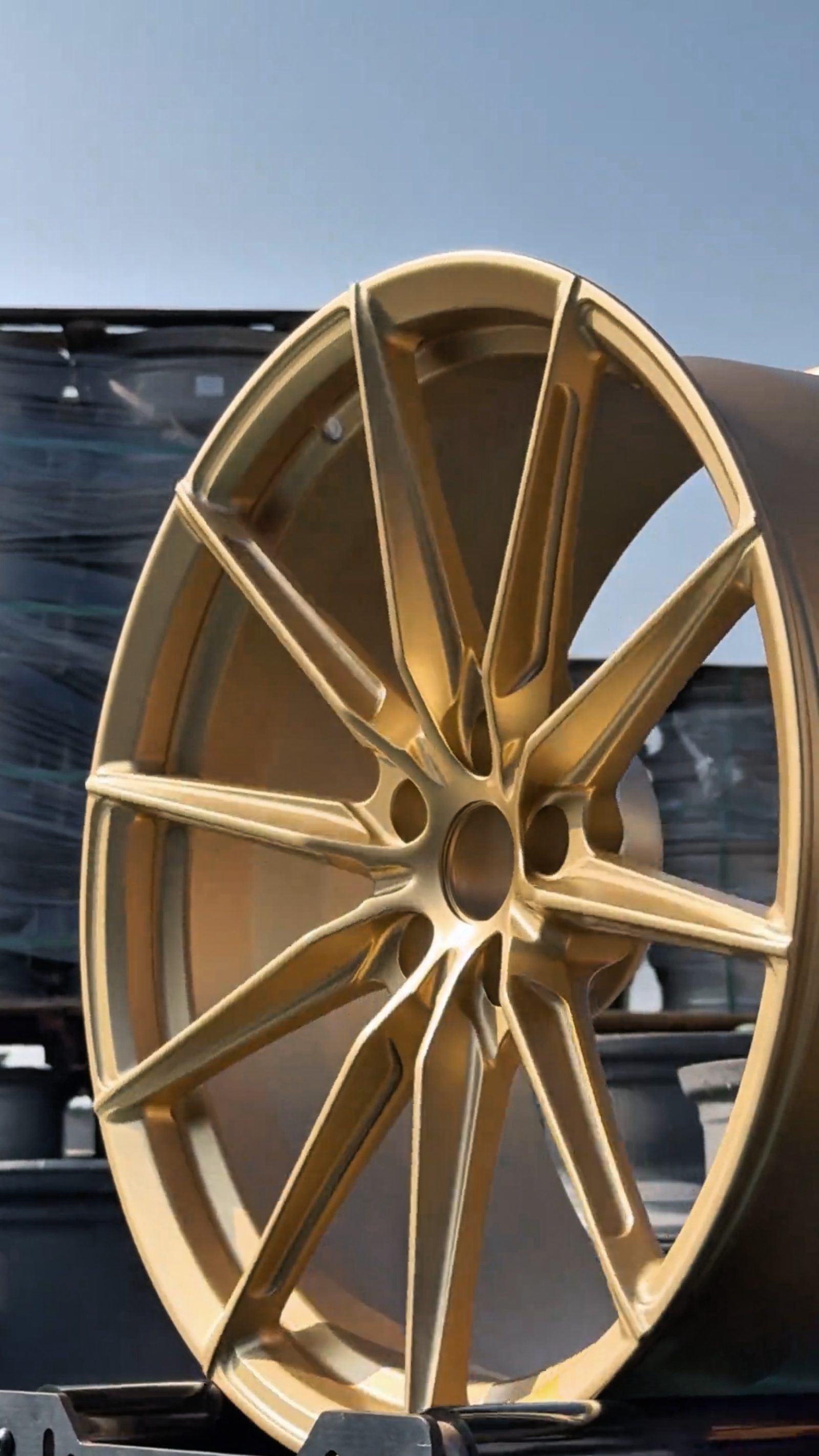
How concave depth is actually produced, why it collides with brake hardware on large luxury saloons, and what a buyer can specify without losing the geometry that makes the look work.
Deep concave forged wheels are defined by one geometric relationship: the spoke face sits substantially inboard of the outer lip, so the wheel reads as a dish rather than as a flat plate. The depth is not a cosmetic add-on applied at the finishing stage. It is created in the forging and fixed by the machining programme, which is why two wheels of the same diameter can look completely different in profile and why a deep design cannot simply be ordered as an upgrade on a shallow tool.
On a luxury car the visual payoff is immediate. A deep face pushes the spokes away from the brake disc, so the wheel draws a long shadow line across the side of the vehicle and makes a large body look lower and wider. The cost is clearance. Every millimetre the spoke face moves inward is a millimetre removed from the space between the spoke and the caliper, and on vehicles with large multi-piston brakes that space is already thin.
This article treats the subject as an engineering specification rather than a styling choice. It covers how depth is measured, how the forging and machining sequence produces it, which fitment limits appear first on heavy saloons and grand tourers, how depth interacts with ride quality, and which finish and inspection decisions protect the look after the first season of use.
What Deep Concave Actually Measures
Buyers often confuse three different numbers: lip depth, concave depth and dish. Lip depth is the width of the polished or painted outer flange as seen from the side. Concave depth is the axial distance between the outermost point of the lip and the lowest point of the spoke face. Dish is the visual impression created by the two together. A wheel with a wide lip and a shallow face can look deep from one angle and flat from another, which is why photographs are a poor specification tool.
The number that governs fitment is the concave depth measured at the spoke, taken along the wheel axis. That figure, combined with the offset, determines where the spoke sits relative to the hub mounting face and therefore how much room remains for the brake caliper. A design that quotes a large concave figure but achieves it mostly through a stepped lip is not the same product as one that achieves it through the spoke profile.
There is also a structural dimension. As the face moves inboard, the angle between spoke and barrel becomes sharper, and the spoke root has to carry a larger bending moment for the same load. That is why a genuinely deep monoblock design needs more material at the root and a different heat treatment verification than a shallow wheel of the same diameter and width, and why depth and load rating have to be specified together rather than sequentially.
How Deep Concave Forged Wheels Are Engineered
A deep concave wheel starts as a forging with enough material in the face region to allow the dish to be cut. That sounds obvious, but it is the main reason deep designs carry a tooling cost: the blank has to be thicker and the press tonnage higher than for a shallow face, because the material that will later become the concave curve must exist before machining begins.
The forging is pressed to a rough dish, then flow formed at the barrel to establish the rim section. Solution treatment and artificial ageing to T6 follow, and only then does the five-axis machining centre cut the concave surface. Cutting the dish after heat treatment matters: the curved surface is where stress concentrations sit, and machining a heat-treated part leaves a cleaner grain structure at the surface than machining before treatment and re heating afterwards.
The final geometry is verified on a coordinate measuring machine against the design model rather than against a sample wheel. That distinction is what separates a repeatable programme from a one-off: a sample can be adjusted by hand until it looks right, while a production batch has to hold the same concave depth across every unit, because a mixed batch produces visible differences when four wheels sit on the same car.
| Decision | What It Controls | Consequence if Chosen Wrong |
|---|---|---|
| Face thickness before machining | Maximum concave depth the tool can produce | Depth is capped, or the spoke root becomes too thin to pass load testing |
| Spoke root radius | Fatigue life under repeated cornering load | A sharp transition develops cracks at the point of maximum moment |
| Spoke inclination at the hub | Caliper clearance and hub face flatness | Contact with the caliper, or an unbalanced spoke loading pattern |
| Barrel profile | Bead seat position and tyre sidewall support | Poor bead seating and sidewall bulge that rubs the arch |
| Machining allowance | Consistency of the concave surface across a batch | Visible step differences between wheels on the same vehicle |
| Finish coverage | How the concave curve catches light | A deep face reads flat when the finish is uniformly matte |
Fitment: The Real Constraints on a Luxury Car
The first constraint is the brake package, not the bodywork. Large saloons and grand tourers increasingly run six-piston front calipers with discs above 400 millimetres, and the caliper body extends outward from the disc face by 60 millimetres or more on some models. A deep concave spoke passes close to that envelope at the point where it turns into the hub, and the interference is usually discovered in a 3D assembly rather than on the car.
The second constraint is the inner wheel arch and suspension upright at full lock. A wider track achieved by reducing offset moves the whole wheel outward, which improves the stance but loads the outer arch liner and can cause rubbing under compression. The third is the outer body surface: on vehicles with pronounced shoulders, a wheel that sits flush at static ride height may protrude when the suspension compresses on a dip.
The practical answer is to specify from a measured vehicle rather than from a table. Ride height, arch clearance, caliper profile and the tyre's actual section width all change the numbers, and a tyre that is nominally the same size from two manufacturers can differ by several millimetres in section width. Our deep concave wheel range is built around a fitment sheet that captures those measurements before a design is released to tooling.
For buyers running a staggered setup, front and rear need separate treatment. The rear usually carries more width and more concave depth because the arch is deeper and the brake package is smaller, while the front is limited by steering sweep and caliper clearance. A programme that copies the rear profile onto the front produces a car that looks right in a photograph and rubs in a car park.
Design Language in Luxury Applications
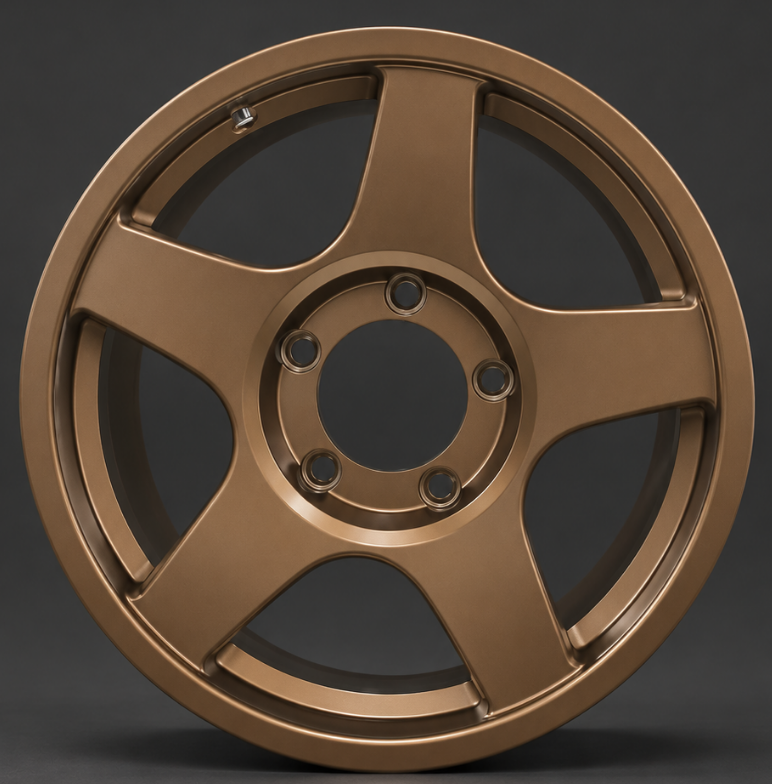
Luxury cars punish busy designs. A large saloon has long horizontal surfaces and a high beltline, and a wheel with many thin spokes disappears into that mass. Five-spoke and split five-spoke layouts with generous window area tend to read better because the concave surface stays visible between the spokes, and the eye follows the curve rather than counting details.
Spoke count also affects how the depth is perceived. Fewer, wider spokes create large windows, which expose the barrel and make the dish look deeper. More, thinner spokes fill the face and flatten the visual effect even when the measured concave depth is identical. This is why a styling decision made from a rendering can disappoint in metal: the renderer shows the profile, the eye reads the shadows.
A monoblock deep concave design keeps the spoke continuous with the barrel, so the shadow line runs unbroken from the hub to the lip. A multi-piece design with a stepped lip can achieve a similar visual result with a different structural logic, and it allows the lip to be replaced after damage. For a luxury owner who rarely uses the car hard, the multi-piece route is often chosen for the serviceability; for a car that is driven, the monoblock route removes the joint that would otherwise need attention.
What buyers should confirm before approving a deep concave design:
- Measured concave depth at the spoke, not the lip width quoted in a brochure
- A 3D clearance check against the actual caliper, not a generic brake template
- Front and rear treated as separate fitments when the setup is staggered
Ride Quality and Performance Trade-offs
A deep concave wheel usually arrives with a wider track and a larger diameter, and both change how the car behaves before the wheel's own mass has any effect. Increasing track width raises the roll centre at the front and adds grip on turn-in, but it also increases scrub radius, which the driver feels as heavier steering at low speed and a stronger pull over camber changes.
Mass distribution matters more than total mass here. A deep face places material further inboard than a flat face of the same weight, because the spokes curve back toward the hub. That reduces rotational inertia slightly at the rim and increases it near the centre, which is the opposite of what a performance buyer wants but is largely irrelevant on a luxury saloon driven at legal speeds.
Where the design does affect comfort is tyre selection. A deep concave 22-inch wheel on a heavy car leaves very little sidewall, and the suspension has to absorb what the tyre cannot. Buyers who prioritise ride quality should consider staying one diameter smaller and using the saved sidewall height, because the visual difference between a 21 and a 22 on a large body is smaller than the comfort difference.
Braking is the third interaction. A larger wheel increases the moment of inertia the brake has to decelerate, and a deep face reduces airflow to the disc because the spoke plane sits further from the outer edge. On a car that is driven hard in mountains, that combination raises disc temperatures, which is one reason track-focused builds rarely use the deepest available profile.
There is a fourth effect that owners notice before any of the above: road noise. A wide, open-spoke wheel with a large barrel acts as a resonator, and on coarse surfaces the tyre cavity noise it transmits into the cabin is louder than a closed face design would produce. Luxury vehicles are usually well insulated at the floor, but the wheel arch is a direct path, so the deeper and more open the design the more the cabin tone changes.
- Choose the diameter by sidewall height, not by photograph. One inch less diameter usually buys back enough sidewall to change the ride on a heavy car.
- Keep the track increase modest unless the suspension geometry is being corrected at the same time, because scrub radius changes are felt through the steering long before they show on a tyre.
- Confirm the load rating for the fully loaded vehicle, not the kerb weight, since a four-seat saloon with luggage and passengers sits well above its published figure.
Finish Options That Complement Depth
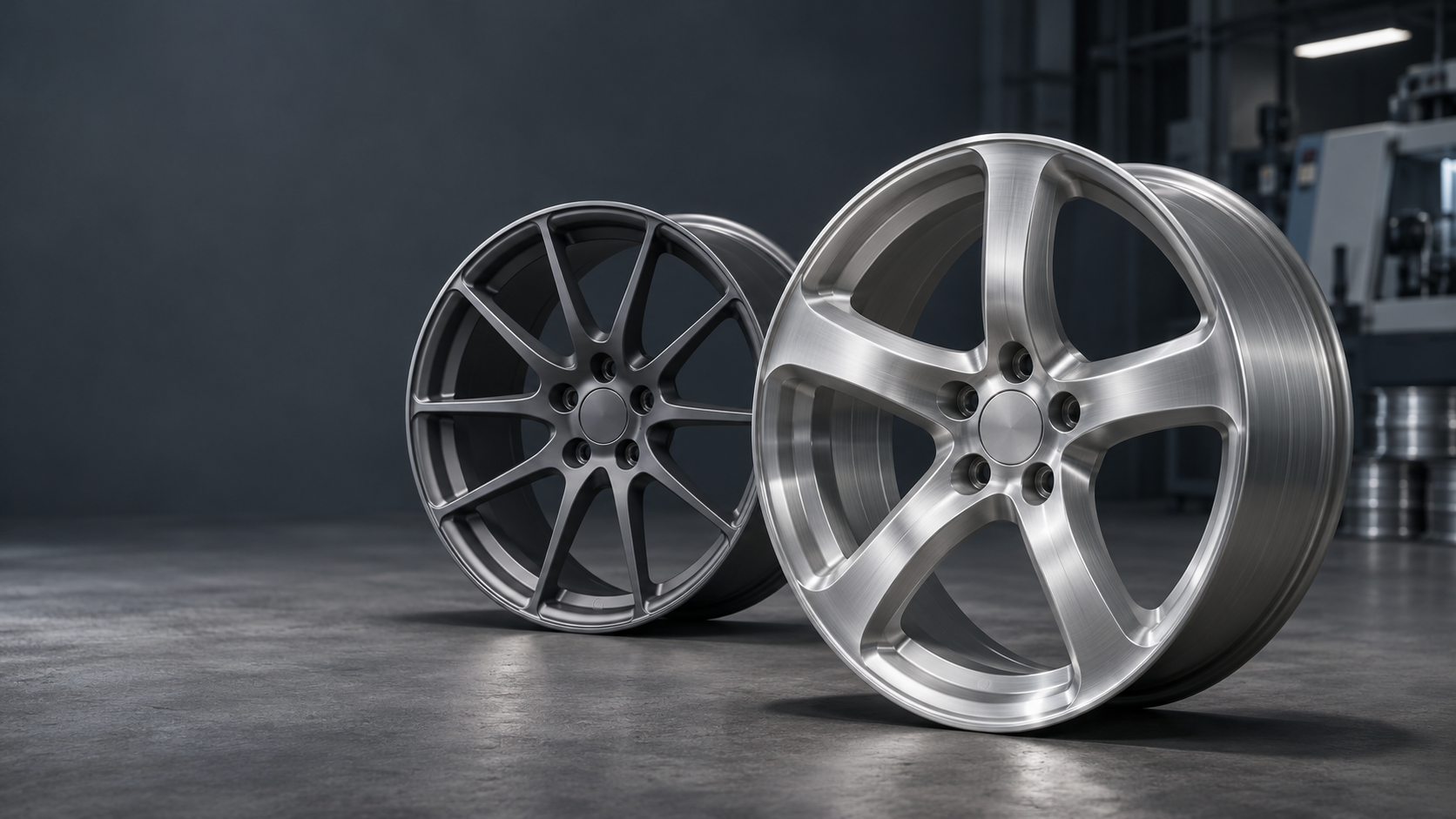
Finish controls how much of the concave curve the eye can read. A brushed or machined face produces directional highlights along the spoke, which traces the curve and makes the depth obvious. A uniform matte finish absorbs light evenly and flattens the same geometry, which is why matte black deep concave wheels often look less dramatic in person than in a photograph taken with strong side lighting.
Two-tone treatment is the most reliable way to emphasise depth on a luxury car. A brushed face with a polished or bright lip separates the two planes visually, and a dark inner barrel adds contrast behind the spokes. Transparent tinted clears over a brushed surface are popular because they keep the metal texture while shifting the colour, and they hide light kerb marks better than a full polish.
Durability has to be considered alongside appearance. A polished lip on a daily-driven car in a winter market will show salt damage within a season unless it is protected, and a re-polish is a wheel-off operation. A painted or powder-coated finish with a clear topcoat survives better, at the cost of the mirror effect. Our forged wheel customization service keeps finish selection separate from structural design, because changing a colour is a production variable while changing a dish is a new tool.
One more practical point applies to any finish that leaves bare metal exposed at the lip. The concave surface holds road film because it faces upward and inward at the same time, so water sits in the transition instead of running off. A coating with a low surface energy helps, but the bigger factor is the owner's cleaning routine: a deep face that is rinsed weekly and dried with a microfibre stays bright for years, while the same wheel left with standing water develops a dull band along the curve that no polish will remove completely.
Quality Checks Specific to Deep Concave Wheels
Runout is the first check and the one most often skipped. A deep face amplifies radial and lateral deviation because the measuring point is further from the hub, so a wheel that passes a runout limit at the lip can still produce a visible wobble at the spoke edge. Buyers should ask for both figures, measured at the bead seat and at the outer lip.
Balance is the second. A deep concave forging removes material asymmetrically, and the resulting mass distribution has to be corrected with weights that do not spoil the finish. Static balance is not enough on a wide wheel; a dynamic balance on a machine that reports both planes is the only useful record, and it should be supplied per wheel rather than per batch.
The third check is load and fatigue testing at the actual rating, not at a nominal one. A 22-inch deep concave wheel for a two-and-a-half tonne saloon carries a different load case from the same diameter on a coupe, and the test report has to name the rating it was performed at. A report without a rating is a document, not evidence.
The fourth is coating adhesion on the concave surface. The curve is the hardest area to coat evenly because the spray angle changes continuously, and a thin patch at the transition shows up as a colour difference within a year. A cross-hatch adhesion test on a production sample, not on a display wheel, is the check that catches it.
How RETA Builds Deep Concave Forged Wheels
RETA has produced forged wheels in Ningbo since 2012, with the company founded in 2009 and a 12,000 square metre plant staffed by more than 100 people. Deep concave work sits in the same production system as the rest of the range, using 6061-T6 and 7075 billet depending on the load class and the depth requested.
The quality system is built on ISO 9001, ISO 14001, ISO 45001 and IATF 16949, with national high-tech enterprise status granted in 2021. Internal test limits are held tighter than the SAE, JWL and PCT sequences we design to, and 30-degree and 90-degree impact and deformation tests are added because those angles reproduce the kerb and pothole loads that a deep face actually sees.
Commercially, the minimum order is one set of four, standard sizes run in roughly 7 to 15 working days and fully custom designs take about 25 to 35 working days. Most deep concave programmes begin from the SSD super concave series, where the geometry already exists, and move to a private tool once a brand has confirmed which fitments and depths sell in its market.
We exhibit at SEMA, where the brand received the 2023 Best Innovative Wheel Brand Award, and the conversations there usually start with a photograph and end with a fitment sheet. The deep concave SUV forged wheel is a useful reference point for how much depth a heavy vehicle can accept once the brake package and arch clearance are measured properly.
Frequently Asked Questions
Q1. How deep can a deep concave forged wheel actually be?
Depth is limited by three things at once: the forging thickness available in the face, the spoke root thickness needed to pass load testing, and the caliper clearance left on the specific vehicle. On a large saloon the brake package usually sets the limit before the forging does, which is why the same design can go deeper on the rear axle than on the front.
Q2. Can a shallow wheel be modified to look more concave?
No. Concave depth is created by removing material from a blank that already has enough face thickness, so a shallow forging cannot be machined into a deep one without cutting into the structural section. A wheel that appears deeper after a refinish has usually gained contrast from the finish, not geometry.
Q3. Do deep concave forged wheels fit cars with large brake calipers?
They fit when the spoke profile is designed around the actual caliper. The usual solution is to flatten the spoke near the hub and let the depth build toward the lip, which preserves most of the visual effect while opening clearance where it is needed. Estimating from a drawing rather than a measured caliper is how fitment failures happen.
Q4. Is a deep concave wheel heavier than a flat face wheel?
Usually slightly, because the forging needs more material in the face region and the spoke root has to be thicker to carry the increased bending moment. The difference is modest on a well-designed part, and it can be offset by reducing mass in the spoke windows and the barrel midsection.
Q5. Which finish best shows the concave curve?
A brushed or machined face with a contrasting lip, because the directional highlight follows the spoke and traces the curve. Uniform matte finishes absorb light and reduce the apparent depth, which is worth knowing before a colour is approved from a photograph.
Send us your model, brake package and arch measurements, and we will specify deep concave forged wheels at a depth the vehicle can actually carry, with the clearance limits stated before tooling starts.
View Concave Designs Request a Fitment Review