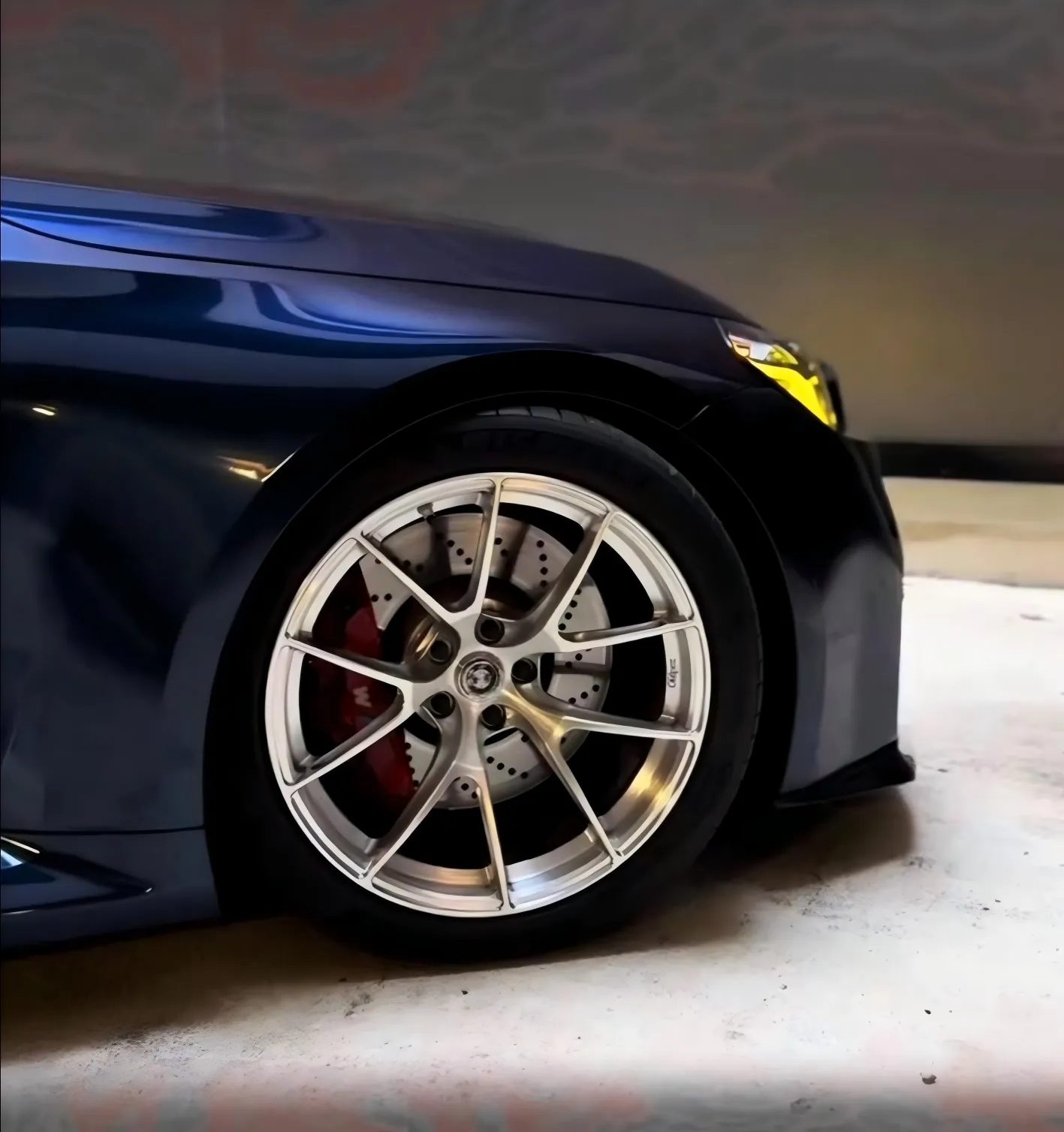
The three numbers that decide whether a wheel fits, how they convert into each other, and why an offset that looks correct on paper can still rub at full lock.
Custom offset forged rims are specified by three dimensions that buyers routinely confuse: width, offset and backspacing. Width is the distance between the bead seats. Offset, usually written ET, is the distance from the wheel's centreline to the mounting face. Backspacing is the distance from the inner edge of the rim to the mounting face. Two of those are the same measurement expressed from different references, and the third is independent.
Because they interact, changing one changes the others. A wider wheel at the same offset moves further inward and further outward at the same time. A lower offset pushes the wheel outward and reduces backspacing. A buyer who orders a width increase without recalculating the offset usually discovers the problem at the inner arch or the outer fender, depending on which side ran out of room first.
This article sets out the arithmetic, the vehicle consequences of each direction, the clearance checks that a static measurement misses, and the way to write an offset specification so that a factory can machine it without guessing what the customer meant.
Width, Offset and Backspacing in Plain Terms
Width is quoted in inches and refers to the distance between the bead seats, not the overall outer width. A wheel described as nine inches wide measures roughly 254 millimetres between the flanges including the flange thickness, which is why the physical width is always a little more than the nominal figure. Tyre manufacturers publish a recommended rim width range for each size, and staying inside it keeps the sidewall in the shape it was designed for.
Offset is measured in millimetres from the wheel's centreline to the mounting face. A positive offset means the mounting face sits outboard of the centreline, which is the normal arrangement on most modern cars. A negative offset places it inboard, producing a deep dish. A zero offset places it exactly on the centreline.
Backspacing is measured from the inner flange to the mounting face, and it is the number that determines inner clearance. It is useful because it describes directly how much room the wheel needs behind the hub, which is where suspension components and inner arches live.
The conversion is straightforward: backspacing equals half the nominal width in millimetres plus the offset. For a nine-inch wheel at ET35, half the width is 114.3 millimetres, so backspacing is 149.3 millimetres. Anyone specifying custom rims should be able to do that calculation in both directions, because a supplier may quote in either unit.
| Nominal Width | Offset | Backspacing | What It Means on the Car |
|---|---|---|---|
| 8.0 in | ET 45 | 146.6 mm | Conservative inner clearance, sits close to the arch |
| 8.5 in | ET 40 | 147.9 mm | Balanced change: 6 mm more inner, 6 mm more outer |
| 9.0 in | ET 35 | 149.3 mm | Common performance fitment, needs inner check |
| 9.5 in | ET 30 | 150.7 mm | Aggressive outer position, arch work often required |
| 10.0 in | ET 25 | 152.0 mm | Rear-axle territory, load and clearance both critical |
What Changing Offset Actually Does
Reducing offset moves the wheel outward. That increases track width, which raises the roll centre at that axle and usually improves turn-in response and grip. It also increases scrub radius, the distance between the steering axis and the tyre contact patch centre, which is felt as heavier steering and stronger reaction over camber changes and braking irregularities.
Moving the wheel outward also increases the bending moment at the hub, because the tyre contact patch is further from the bearing. That shortens bearing life and increases the stress at the hub flange. A modest change is usually harmless; a large one on a heavy vehicle is a durability decision rather than a styling decision.
Increasing offset does the opposite. It pulls the wheel inward, which tightens the stance against the arch and reduces scrub radius, but it also moves the inner edge closer to the suspension and can produce contact with a control arm, a shock body or the inner liner. On vehicles with a large brake package, the caliper is usually the first thing it meets.
Width changes are often mistaken for offset changes. Going from 8.5 to 9.5 inches at the same offset adds 12.7 millimetres of width to each side of the centreline, so the wheel grows inward and outward simultaneously. Buyers who expect a wider wheel to sit flush and find it rubbing inside have usually changed width without adjusting offset to compensate.
Matching Rim Width to the Tyre
Every tyre size has a recommended rim width range, and the range matters more than the single number a tyre shop might quote. Mounting a tyre at the narrow end of its range produces a rounder sidewall and more protection for the rim; mounting at the wide end produces a squarer shoulder and more responsive steering, at the cost of a harsher ride and a more exposed lip.
Stretching a tyre beyond its recommended range is a styling choice with functional consequences. The sidewall tilts inward, the rim sits proud of the tyre, and the load rating of the assembly is no longer what the tyre manufacturer validated. For a road car in a market with annual inspection, that can also be a compliance issue.
The other direction has its own problem. A tyre that is too wide for the rim bulges, the contact patch loses shape and the steering feels vague. It also runs hotter at the shoulder, which accelerates wear on the outer edge and can produce a temperature imbalance across the tread.
For a performance fitment, the usual approach is to choose the tyre first, then select a rim width near the middle or upper-middle of its range. That keeps the sidewall supported without stretching it, and it leaves the rim protected from kerb contact by a small amount of sidewall overhang.
Measuring a Car Before Ordering Custom Offset Forged Rims
The measurement process starts with the car at its final ride height, on the tyres it will actually run. Measure from the hub mounting face to the inner arch liner, then to the outer arch lip, at the height of the wheel centre. Those two figures bound the available space, and the difference between them is the maximum installed width including the flanges.
The second measurement is brake clearance. Place a straight edge across the hub face and measure the axial distance to the outermost point of the caliper, then the radial distance from the hub centre to the caliper's outer edge. Those two numbers define the envelope the spoke must avoid, and they are the measurements most often missing from a customer's brief.
The third is suspension clearance at full lock and full compression. Turn the steering to both locks and check the gap between the tyre and the inner arch, the liner and any suspension component. Then compress the suspension on one side, either with a jack under the lower arm or on a ramp, and repeat the check. Static clearance at ride height tells you almost nothing about what happens on a bump.
A measurement sheet with photographs of each check is worth more than a long email. Our forged wheel fitment guide uses the same structure, and it is the reference we ask customers to work from before a custom offset is quoted.
Staggered Setups and Axle-by-Axle Thinking
A staggered setup uses different widths front and rear, and it requires different offsets on each axle. Treating the rear specification as a template for the front is the most common error in a custom order, because the front axle has steering sweep and a larger brake package while the rear has neither.
The front usually needs a narrower wheel and a slightly higher offset to preserve steering clearance and keep the scrub radius within reason. The rear can carry more width and a lower offset because the arch is deeper and the wheel does not steer. That asymmetry is normal and should be specified deliberately.
On an all-wheel-drive vehicle, the rolling circumference of the front and rear tyres should stay close, which constrains how different the two axle diameters can be. Width can differ more freely than diameter, which is why most staggered setups keep the same diameter and change only the width and offset.
A note on rotation: a staggered setup cannot be rotated front to rear, so tyre wear becomes a replacement decision rather than a maintenance one. Buyers should factor that into the ownership plan, particularly on a car with a torque-biased rear axle.
Why Two Cars With the Same Numbers Behave Differently
Two owners of the same model can order identical width and offset and get different results, because the cars are not identical where it matters. Ride height, suspension bushing condition, arch liner fitment and even the tyre brand all move the effective clearance by a few millimetres, and a few millimetres is the whole margin on a tight fitment.
Brake packages are the largest single variable. The same body shell can be sold with several caliper and disc combinations depending on market and trim, and the outer edge of the caliper is often the closest point to the spoke. A fitment validated on one trim can fail on another trim of the same model year.
Body tolerances are the second variable. Panel alignment and arch lip thickness vary between individual cars, particularly on vehicles that have had paint or bodywork. A clearance measured on one car is a data point, not a universal specification.
The third is suspension condition. Worn bushings, sagging springs and aftermarket arms all change the geometry, and a car that has covered a hundred thousand kilometres sits differently from a new one even at the same nominal ride height.
The practical conclusion is that a fitment should be specified for a specific car rather than for a model. That is inconvenient for a brand trying to build a catalogue, and it is exactly why a custom offset programme exists alongside the standard range.
How to Write an Offset Specification
A usable specification states diameter, width, offset, bolt pattern, centre bore and load rating, in that order, with the tyre size alongside. Anything less invites a supplier to fill the gaps with an assumption, and the assumption will be based on a similar car rather than on yours.
The offset should be expressed in millimetres with its sign, and the backspacing should be stated as a cross-check. If the two figures do not agree with the width, one of them is wrong, and catching that before machining is far cheaper than catching it at the fitting bay.
Tolerance should be agreed explicitly. A custom forged rim can usually be machined to a tight offset tolerance, and a buyer who specifies plus or minus one millimetre is asking for something achievable. A buyer who assumes that tolerance without stating it may receive a wheel that is within a wider default band.
Finally, the specification should record the vehicle it was designed for, including any suspension modification. That line is what allows a replacement wheel or a second set to be produced correctly two years later, and it takes ten seconds to write.
A custom offset brief should contain these six lines:
- Diameter and nominal width, with the tyre size and model that will be fitted
- Offset in millimetres with sign, and backspacing as a consistency check
- Bolt pattern, centre bore and the load rating for the built vehicle
Clearance Problems That Only Appear in Motion
The first is tyre growth at speed. A tyre expands slightly under centrifugal load, and a gap that measures five millimetres at rest can close at high speed. On a car with tight arch clearance, that is enough to touch a liner on a fast compression.
The second is suspension bushing deflection. Rubber bushings move under cornering load, changing the wheel's position relative to the arch by several millimetres. A clearance measured on a stationary car assumes the bushings are at rest, which they are not under load.
The third is steering geometry under compression. Turning the wheel at ride height does not reproduce the position of the tyre at full lock with the suspension compressed, and that combination is where most front rubbing occurs.
The fourth is brake heat. A caliper expands when hot, and a clearance that is adequate cold can close after a hard stop. On a track-driven car this is a real constraint, and it is one reason a fitment that works on the road may not work on a circuit.
- Leave a working margin at every measurement point rather than aiming for zero clearance.
- Check clearance with the suspension compressed, not only at ride height.
- Confirm caliper clearance with the brake hot if the car is driven hard.
- Re-check after the first hundred kilometres, when the suspension has settled.
Load Rating and Offset Have to Be Decided Together
A wheel's load rating is established for a specific geometry, and offset is part of that geometry. Moving the mounting face changes the bending moment at the hub and the spoke, so a design validated at one offset does not automatically carry the same rating at another. The difference is usually small for a modest adjustment and significant for a large one.
This matters most on heavy vehicles and on wheels with a deep concave face, where the spoke already sits well inboard and the hub is doing more work. A customer who asks for a lower offset on an already aggressive design is asking for a change in the load path, and the answer should come from the engineering side rather than the order desk.
The practical rule is to state the load rating on the specification and to require confirmation that it still applies at the requested offset. A supplier who confirms in writing has done the check; one who confirms verbally has probably not.
The same logic applies to width. A wider wheel at the same offset carries the load through a longer lever from the hub, and the spoke root sees a correspondingly higher moment. That is why a width increase is a design review rather than a line item, and why the answer sometimes includes a thicker spoke or a different alloy for the same visual result.
How RETA Machines Custom Offset Rims
RETA has produced forged wheels in Ningbo since 2012, with the company founded in 2009, a 12,000 square metre plant and more than 100 staff. Offset, width, bolt pattern and centre bore are machining variables on an existing forging, so a custom fitment can be produced without new tooling as long as the hub thickness stays inside the design window.
The quality system covers ISO 9001, ISO 14001, ISO 45001 and IATF 16949, with national high-tech enterprise status granted in 2021. Internal limits are held tighter than the SAE, JWL and PCT sequences we design to, and 30-degree and 90-degree impact and deformation tests are added because a fitment that is tight against an arch is also a fitment that is likely to meet a kerb.
Commercially, the minimum order is one set of four wheels, standard sizes run in roughly 7 to 15 working days and fully custom designs take about 25 to 35 working days. Offset changes on an existing design fall into the shorter band, which is why most first orders start from a proven geometry such as the deep concave forged wheel designed for the G82 platform and then adjust width and offset to the customer's measurements.
We exhibit at SEMA, where the brand received the 2023 Best Innovative Wheel Brand Award, and fitment questions there are usually settled with a tape measure and a photograph rather than a catalogue. That is the right method for custom offset forged rims, and it is why we ask for measurements before a quotation is issued.
Frequently Asked Questions
Q1. Does a lower offset always mean the wheel sticks out more?
Yes, at the same width. A lower offset moves the mounting face inboard relative to the wheel centreline, which pushes the whole wheel outward. The amount it protrudes also depends on width, so a narrower wheel with a low offset can sit in a similar place to a wider one with a higher offset.
Q2. Can I change offset without changing the wheel design?
On a forged wheel, offset is a machining dimension, so it can often be changed on an existing design within the hub thickness window. Beyond that window the forging changes, which is the point at which a fitment request becomes a new design project.
Q3. What is the difference between ET and backspacing?
ET is measured from the wheel centreline to the mounting face, while backspacing is measured from the inner flange to the mounting face. Backspacing is more directly useful for checking inner clearance, and the two convert through the nominal width.
Q4. How much can I widen a wheel before the arch needs work?
There is no universal figure, because the available space depends on the arch, the ride height and the tyre. The only reliable answer comes from measuring the car at its final height and cycling the suspension with the intended tyre fitted.
Q5. Is a staggered setup worth it on a road car?
It suits rear-driven cars with a powerful engine, where the rear axle benefits from more width, and it is common on performance models from the factory. The cost is that tyres cannot be rotated front to rear, which shortens the replacement cycle.
Send us your measurements, tyre choice and ride height, and we will return custom offset forged rims with the width, ET and backspacing that actually fit the car, checked before machining.
Browse Forged Wheels Send a Fitment Sheet