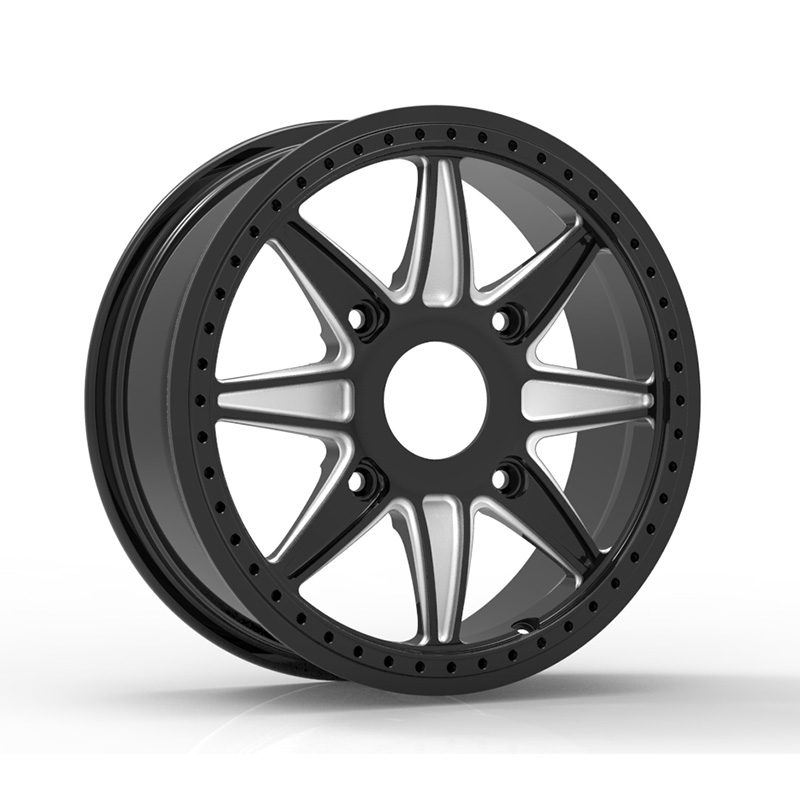
What the alloy actually delivers after heat treatment, how it compares with 7075 in a wheel application, and why the T6 condition is a process record rather than a label stamped on a specification sheet.
6061-T6 forged wheels are made from an aluminium-magnesium-silicon alloy that has been forged into shape and then heat treated to the T6 condition, which means solution treatment followed by artificial ageing. The result is a material with roughly three times the tensile strength of the same alloy in its annealed state, combined with enough elongation to deform rather than shatter when it hits a kerb.
That balance is the reason the alloy dominates forged wheel production worldwide. Stronger alloys exist, and some of them are used in wheels, but strength alone is a poor selection criterion for a part that has to survive impact, corrosion, cyclic loading and a cosmetic finish. The engineering question is which alloy and which temper give the best combination across all four.
This article covers the metallurgy in practical terms, the properties that matter at each stage of wheel design, the manufacturing advantages that come from the alloy rather than from the forge, the difference between a genuine T6 part and a part that is merely called T6, and the applications where 6061-T6 is the correct choice and where it is not.
What 6061-T6 Means at the Metallurgical Level
The 6061 designation describes the chemistry: aluminium with magnesium as the primary alloying element, silicon as the second, plus small additions of copper and chromium. Magnesium and silicon combine during heating to form magnesium silicide, and it is the controlled precipitation of that phase which produces the strength gain during ageing.
Solution treatment raises the part to a temperature where the alloying elements dissolve into a single solid phase, then quenches it quickly enough to hold them in supersaturated solution. Artificial ageing then holds the part at a lower temperature for a defined period, allowing fine precipitates to form throughout the grains. Those precipitates impede dislocation movement, which is what a higher yield strength actually means at the microstructural level.
The T6 temper is therefore a definition of a process, not a property of the alloy. Undershoot the ageing time and the part is under-aged and weaker than specified. Overshoot it and precipitates coarsen, which raises hardness slightly while reducing toughness. Both errors are invisible on a finished wheel, which is why the heat treatment record and its link to a serial number matter more than any label applied to the rim.
Quench rate deserves the same attention. A slow quench leaves the part unable to reach full strength in later ageing, and it introduces residual stress that shows up as distortion during machining. For a wheel, where the barrel and the face have very different section thicknesses, quench uniformity is one of the hardest parts of the process to control and one of the clearest indicators of a capable supplier.
Mechanical Properties That Matter in a Wheel
In the T6 condition, 6061 typically reaches a tensile strength in the region of 290 to 310 megapascals, a yield strength around 240 to 275 megapascals, and an elongation of roughly 8 to 12 percent depending on section thickness and product form. Hardness sits near 95 on the Brinell scale. These are the numbers a wheel designer starts from, and each one maps to a different failure mode.
Yield strength governs the load at which the wheel begins to deform permanently, which is the relevant limit for pothole strikes and kerb impacts. Tensile strength governs the point of fracture and is the ceiling that a fatigue calculation works back from. Elongation governs what happens after yield: a material with reasonable elongation bends and holds together, while a brittle one cracks and separates.
Fatigue strength is the property that decides service life rather than single-event survival. A wheel accumulates millions of small load cycles, and a spoke root that is designed only against static yield will eventually crack. Forged 6061 has an advantage here because the forging process produces a continuous grain flow that follows the part's contours, so the material is oriented along the load path instead of being cut across it.
Corrosion resistance is the fourth property and the one most often sacrificed in pursuit of strength. 6061 has good resistance to atmospheric corrosion because of its magnesium-silicon chemistry and its natural oxide layer, and it responds well to anodising. An alloy with a higher strength ceiling may need more careful protection, which is a cost that appears years later rather than at the quotation stage.
| Property | 6061-T6 Typical | What It Controls in a Wheel |
|---|---|---|
| Tensile strength | About 290 to 310 MPa | Fracture limit used as the basis for fatigue calculation |
| Yield strength | About 240 to 275 MPa | Onset of permanent deformation in an impact |
| Elongation | About 8 to 12 percent | Whether the wheel bends or cracks at the limit |
| Hardness | About 95 HB | Wear resistance at the bead seat and kerb contact points |
| Density | About 2.70 grams per cubic centimetre | The mass baseline against which section design is optimised |
| Thermal conductivity | About 167 watts per metre kelvin | Heat path from the brake disc into the wheel and hub |
6061-T6 Against 7075 in Wheel Applications
7075 is the alternative most often raised in a specification discussion, because its strength figures are substantially higher: tensile strength can exceed 500 megapascals in the T6 temper, with yield above 430. On paper that suggests a lighter wheel for the same load, and in certain applications it delivers exactly that.
The trade is toughness and corrosion behaviour. 7075 uses zinc as its primary alloying element, which raises strength but reduces resistance to stress corrosion cracking and makes the alloy less forgiving at stress concentrations. It also anodises to a different visual result and requires more careful process control to keep a cosmetic finish consistent across a batch.
The practical split is by duty. A wheel for a heavy SUV, a commercial vehicle or a part that will see kerb strikes benefits from the elongation and corrosion margin of 6061-T6. A competition wheel where mass is the dominant constraint and the part is inspected frequently can justify 7075. Many factories, including ours, run both and select per programme rather than declaring one alloy universally superior.
There is a commercial dimension too. 7075 billet costs more and machines differently, and the scrap rate on a complex face design is higher because the alloy is less tolerant of interrupted cuts and thin sections. A buyer comparing two quotations should check which alloy each one assumes before concluding that one factory is more expensive than another.
Manufacturing Advantages of the Alloy
The first manufacturing advantage is forgeability. 6061 flows well under the press at forging temperature, which allows a complex face with deep concave geometry to be produced from a single billet without laps or folds. Alloys with higher strength ceilings tend to be less forgiving in the same operation, which limits how much shape can be produced before machining.
The second is machinability. The alloy cuts cleanly at the feeds and speeds used on five-axis centres, produces manageable chips and holds dimensional tolerance well. That translates into fewer tool changes, less spindle downtime and a more predictable machining cost per wheel, which matters when a programme runs to thousands of units.
The third is surface treatment compatibility. 6061 anodises evenly and takes paint, powder coat and polished finishes without the patchiness that some high-strength alloys show. For a product where the finish is a large part of the value proposition, that compatibility reduces rework and makes colour matching across a batch realistic.
The fourth is repairability. A 6061 wheel that has suffered minor deformation can sometimes be straightened within a defined tolerance by a specialist, because the alloy retains enough ductility to move without cracking. That option rarely exists with a more brittle high-strength material, and it changes the ownership cost of the product in markets where replacement is slow.
How the Forging Process Changes the Material
A cast wheel and a forged wheel can carry the same alloy designation and behave completely differently. Casting pours liquid metal into a mould, and the resulting microstructure contains dendritic arms, shrinkage porosity and a grain structure that follows the cooling direction rather than the load direction. Forging takes a solid billet, heats it and deforms it under pressure, which closes internal voids and aligns the grain with the flow of material.
That alignment is the reason a forged wheel can be thinner in the spoke without losing fatigue life. The grain boundaries run along the spoke rather than across it, so the material resists crack initiation in the direction where the cyclic stress is highest. It is also why the forging direction matters: a part forged with the wrong grain orientation can be no better than a casting despite the higher process cost.
Flow forming extends the same logic to the barrel. The rim section is spun and thinned under controlled pressure, which work-hardens the material and produces a continuous wall without a weld. A welded barrel introduces a heat-affected zone where the temper is altered, and that zone is exactly where a crack will start under repeated bending.
The sequence of operations after forming is equally important. Heat treatment before machining, machining to final geometry, then a stress-relief step where the design requires it, keeps distortion under control and preserves the surface condition that fatigue life depends on. A shop that machines first and treats later is producing a different product with the same alloy name.
What a genuine T6 record should contain for each batch:
- Billet heat number and the alloy certificate that traces it to the mill
- Solution treatment temperature, soak time and quench delay
- Ageing temperature and duration, with the furnace chart retained
Verifying the Temper Instead of Trusting the Label
The cheapest verification is hardness testing. A Brinell or Webster reading taken on a prepared area of the hub face will separate a properly aged part from an under-aged one within a few points. It is a screening test rather than a proof, because hardness and tensile strength do not track perfectly across section thicknesses, but it catches the gross process failures.
Tensile testing of a coupon cut from a sacrificial part is the stronger check, and it should be done per heat treatment batch rather than per order. Conductivity testing is a third option used in aerospace practice: the electrical conductivity of the alloy changes with temper, so a reading outside a defined window indicates that the ageing cycle was not as recorded.
For buyers without a laboratory, the practical route is documentation plus a sample cut. Ask for the furnace chart for the batch that produced your order, then cut one wheel from the batch and have a local lab report tensile and elongation. The cost of that single test is small compared with the cost of discovering an under-aged batch after it has been distributed.
Where 6061-T6 Forged Wheels Reach Their Limit
The first limit is a very aggressive mass target. When a programme demands the lowest possible weight for a given load, section thicknesses shrink until the design relies on the alloy's strength rather than its toughness, and at that point a higher-grade material becomes the more rational choice. A 6061 wheel pushed to that edge loses the impact margin that made it attractive in the first place.
The second limit is sustained high temperature. Ageing behaviour is time and temperature dependent, and a wheel that runs continuously at elevated temperature near the brake package will over-age slowly, losing a small amount of strength over years of hard use. The effect is modest on a road car and relevant on a competition car with restricted brake cooling.
The third limit is the welding temptation. 6061 is weldable, which is precisely why some repair shops attempt to weld a cracked spoke. Welding destroys the T6 temper in the heat-affected zone and leaves a local region far weaker than the parent metal, so a welded structural repair converts a damaged wheel into an unpredictable one. This is a case where the alloy's versatility works against it.
Knowing those limits is what allows a supplier to say no to a request that would produce a technically compliant but commercially fragile product. A buyer who understands where the material stops performing well can specify around it, either by accepting slightly more mass or by moving to a different alloy for the specific programme.
Applications Where 6061-T6 Forged Wheels Fit Best
Heavy vehicles are the clearest case. An electric SUV or a large saloon carries a static load that pushes section thickness up, and at those thicknesses the toughness advantage of 6061 matters more than the strength ceiling of a higher-grade alloy. The same logic applies to commercial and military patterns, where impact resistance and repairability outweigh the last few hundred grams.
Cosmetic programmes are the second case. A wheel sold largely on its finish benefits from an alloy that anodises and coats consistently, and the strength margin of 6061-T6 is already far above what a road wheel needs when the design is correct. The elegant series is built on this principle: the material is chosen for finish consistency and road durability rather than for a specification sheet headline.
Electric vehicle programmes are the third, and the fastest growing. An EV adds mass, adds torque at the wheel and removes engine noise that used to mask road vibration, so the wheel has to be quiet, strong and efficient. The material's thermal conductivity also helps move brake heat into the hub instead of concentrating it at the disc face, which is a small but real contribution to consistent braking.
Our own production reflects that shift. The SSD new energy series is specified around EV load cases, and the engineering note on how 6061-T6 forged aluminium wheels affect EV range and safety sets out the reasoning behind the alloy choice in more detail.
- Heavy saloons and SUVs, where section thickness is set by load rather than by style and toughness decides impact behaviour.
- Electric vehicles, where added mass, instant torque and low cabin noise change what a wheel has to do.
- Cosmetic-led programmes, where an even anodised or painted finish across a batch matters as much as the strength margin.
- Fleet and export orders, where repairability and consistent supply weigh more heavily than a weight figure on a brochure.
How RETA Works With 6061-T6
RETA has produced forged wheels in Ningbo since 2012, with the company founded in 2009, a 12,000 square metre plant and more than 100 staff. 6061-T6 programmes run alongside 7075 work, and the alloy for each project is selected against the vehicle load class, the target mass and the finish requirement rather than by default.
The quality system covers ISO 9001, ISO 14001, ISO 45001 and IATF 16949, with national high-tech enterprise status granted in 2021. Internal acceptance limits are held tighter than the SAE, JWL and PCT sequences we design to, and 30-degree and 90-degree impact and deformation tests are added because those angles reproduce the loads that actually damage a road wheel.
Commercially, the minimum order is one set of four wheels, standard sizes run in roughly 7 to 15 working days and fully custom designs take about 25 to 35 working days. Most programmes begin from the one part forged wheel range, where the tooling already exists, before moving to a private design with its own material specification.
We exhibit at SEMA, where the brand received the 2023 Best Innovative Wheel Brand Award. The technical questions we get there have shifted over the years from diameter and finish toward load rating, temper verification and EV fitment, which is a healthier conversation for everyone involved in the supply chain.
That shift is worth noting for any brand building a catalogue. Ten years ago a specification sheet could sell a wheel on appearance alone; today a distributor will ask for the load rating, the alloy certificate and the test standard before placing a first order. A supplier who can answer those questions quickly wins the programme, and a supplier who has to go and find the answers reveals how much of the process is actually under control.
Frequently Asked Questions
Q1. Is 6061-T6 strong enough for a forged wheel?
Yes, comfortably, provided the design uses the material properly. A correctly designed 6061-T6 monoblock meets the load and fatigue requirements of road vehicles from passenger cars to heavy SUVs. The failure cases that reach the market are usually design or process failures rather than alloy limitations.
Q2. Is 7075 better than 6061 for wheels?
It is stronger and can be lighter for a given load, but it is less tolerant of stress concentrations and less forgiving in corrosion terms. For competition use with frequent inspection it can be the right choice; for road use on heavy vehicles the toughness and finish consistency of 6061-T6 usually win.
Q3. How can a buyer tell whether a wheel is really T6?
Ask for the heat treatment record tied to the batch, then verify with a hardness reading on a prepared surface or a tensile test on a coupon cut from a sacrificial wheel. A supplier that can produce both the chart and the test result is describing a controlled process rather than a marketing claim.
Q4. Does forging change the alloy or only the shape?
The chemistry stays the same, but the microstructure changes. Forging closes porosity and aligns grain flow with the part contour, which raises fatigue life and allows thinner sections. That is why a forged 6061 wheel and a cast 6061 wheel of the same weight do not perform the same way.
Q5. Can 6061-T6 wheels be repaired after minor damage?
Minor deformation can sometimes be corrected within a defined tolerance, because the alloy retains useful ductility. Cracks, heavy deformation or damage at a spoke root are not repairable, and any repair should be assessed by a specialist against the original geometry rather than by eye.
Send us your vehicle load case and target mass, and we will confirm whether 6061-T6 forged wheels or a 7075 programme suits the application, with the temper record and test data supplied for the batch.
Browse Forged Wheels Ask a Material Question